Showing posts with label maui. Show all posts

Monday, August 8, 2011

Service vs. Sustainability

Since day one, environmental sensitivity has been a priority at Extended Horizons. Sounds corny and unbelievable, right?   Way back... in the late 1980's owner, Erik Stein, saw the potential damage to Maui's reef from boat anchors and decided to get involved and do something about it. He began working with partners from the Big Island of Hawaii and other operators on Maui, to help spearhead efforts to put permanent mooring buoys in at popular dive and snorkel sites in Maui County. As EH grew, Erik redefined the list of services offered to include Environmental Consulting when incorporating EH in the State of Hawaii in 1996. This was done with an eye on keeping the mooring program a viable part of the corporate mission so that Extended Horizons Inc. would continue to see efforts for mooring placements as integral to the company's focus.

Day-Use Mooring Buoys
help protect Maui's reefs from anchor damage.

Fast forward to Y2K... EH makes another leap toward sustainability by converting operation of our boat to 100% recycled biofuel made locally here on Maui. Just to be clear, that means our boat runs on 100% biodiesel, which is made from 100% reused vegetable oils, collected from local sources here on Maui. In fact, PADI's professional magazine, The Undersea Journal, recently highlighted EH's green efforts in an article about Going Green. The jump to biodiesel required a few modifications to the boat, and also to the warehouse for fuel storage. And yes, it does cost a bit more than regular petroleum based diesel fuel... but the feel-good aspect outweighs the costs.

Local Maui company, Pacific Biodiesel, makes our biofuel.

A few years after that, when bottled water became the norm around 2005, EH stopped serving beverages in paper cups as we had been doing since the 80's... EH has a recycling station in the warehouse for plastic bottles, aluminum, cardboard (and of course biodiesel!).


It may not be pretty to look at,
but think how much prettier to environment is because of these recycling efforts!


And now here we are in 2011... after six years of recycling thousands of individual, disposable plastic bottles, we've decided it is time for a change. We recently went through another renovation at our warehouse to update our classroom space and build out the downstairs area to accommodate a dishwasher. With a sanitizing system in place, a RO system installed, and BPA Free Nalgene bottles purchased, we are now able to serve reusable bottles to our customers... putting us one step closer to zero waste operations!

Even though EH recycled, it wasn't good enough.

It has taken a month or so for the EH Crew to streamline an organization system for each customer to have a reusable bottle, with multiple refills throughout the day... it was definitely easier to throw away (or recycle) the single-use bottles... but we think it's worth the extra effort and we hope you do too!

Use of reusable bottles like these BPA Free Nalgene,
is one way to make your own move toward sustainability!

Friday, April 29, 2011

374 lbs of debris removed from reef!


The results are in! This was by far our most successful reef cleanup in terms of how much debris was removed from the reef. This year Mike Severns Diving hosted our annual Earth Day Underwater Reef Cleanup Event, and their crew, plus the crew of Extended Horizons and a few select friends removed 374 pounds of trash and fishing tackle off the reef along the southern coast of Maui!!!


That was:
47 pounds of fishing line (monofiliment)
327 pounds of fishing tackle (lead sinkers/grabbers)
We're estimating that the size of the area of
reef we cleaned was approximately 100 sq. ft.
There was so much more to be cleaned,
but our bottom time wouldn't allow.

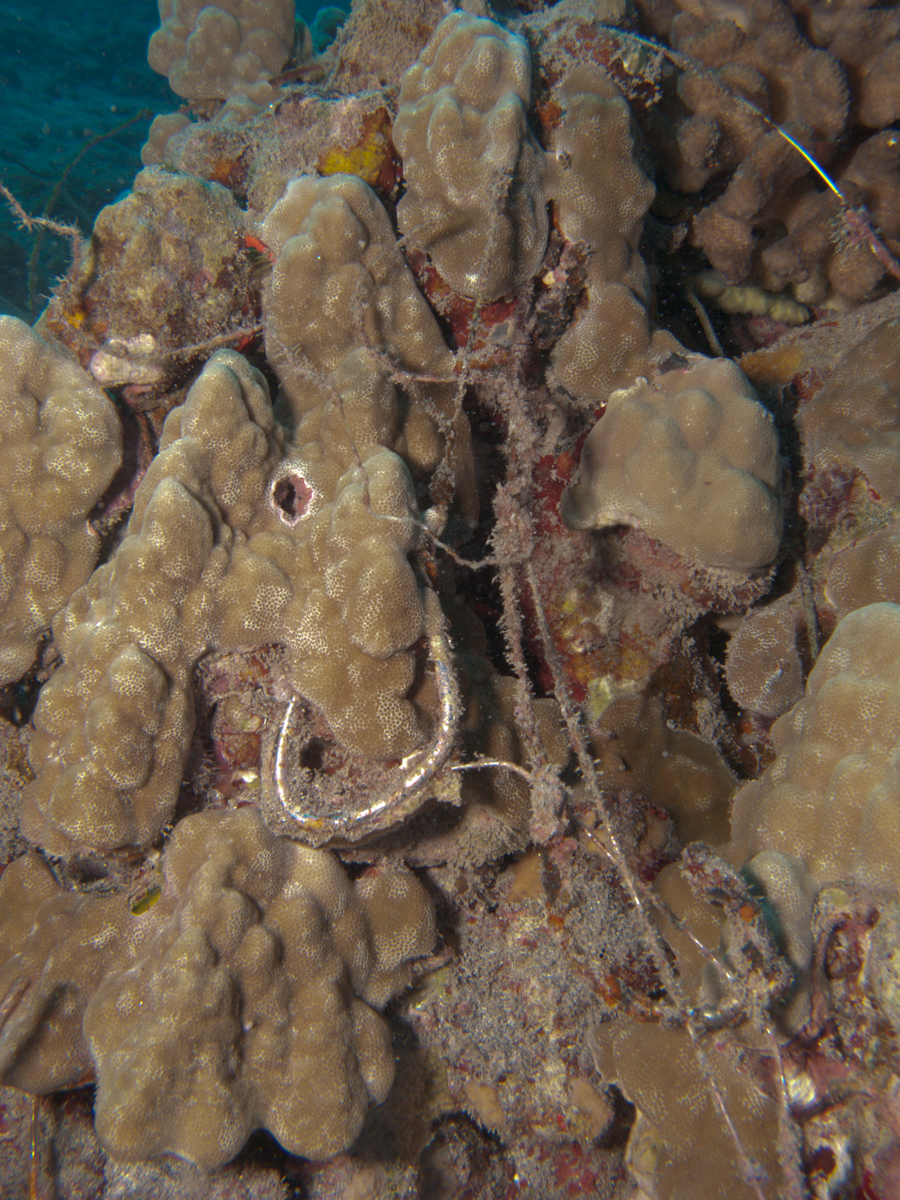
Each time we hold a reef cleanup we try to target areas that are commonly fished; often these areas are often along rocky cliffs. Take a look at what we're seeing underwater!


We often get the question: 
'why is there so much stuff left of the reef?'
One common-sense answer is that sometimes when fishing, the fishing line breaks... however, in the areas that we clean, more often than not, the answer is that the fishing technique used is 'slide-bait fishing.'  This requires use of 'sacrificial'  lead grabbers and some monofiliment, called the 'lead line.' The combination of a cliff-like, rocky shoreline environment  +  the slide-bait fishing technique... the result is that the fishermen are unable to retrieve the debris that is intentionally left on the reef.


So... what's the harm? 
Won't it just become part of the reef over time?
It is true, that if left long enough, all of the debris will become part of the reef... however, it may not end up being the type of reef it was initially! Things will gradually shift from a coral dominated reef to an algal dominated reef.


We're talking about two components: monofiliment line & lead grabbers.
  1. The monofiliment fishing line tangles easily around the live corals. But it's pretty thin and doesn't really do any damage, right? Yes & No. The line itself isn't what is harmful to the corals, although it does take upwards of 600 years for monofiliment to break down in the environment. The line creates spiderwebs criss crossing over the tops of lobe and finger corals, or bunches up like a baseball cap over the top of cauliflower coral heads... and the line is the perfect environment for algae to grow on. You see, those corals and algae are both looking to access the sunlight. With a 'bonnet' or 'spiderweb' of algae growing over them, the corals will not be successful, and often eventually die. Additionally, the algae grazers, such as urchins, also become tangled in the line... what is left becomes an algal dominated reef.
  2. The lead grabbers... might at first seem inert, and are often seen overgrown by corals... but recent documentation is revealing some startling effects where lead poisoning is traveling through the food chain. So do we really know for sure? Read more

Some might ask... why continue to allow this?
From Googling "slide bait fishing" you can see that the target fish for this technique are giant trevally jacks. Here in Hawaii, fishing is a part of the culture, and the result of landing a big jack... you instantly become part of your community's legends! So disallowing something so close to the heart of the community is not a viable solution.


So, what can be done?
Well, at the very least... getting groups out there to clean up the rubbish is step 1. Extended Horizons hosts cleanup events each Spring and Fall, in honor of Earth Day and International Coastal Cleanup Day. I've also heard about some eco-leaning fisherman choosing to use twine instead of monofiliment as their lead line (something more organic to be left behind). But the next step is to start taking a look as a community at this issue, and see if this is something we want to see change.


All in all... our reef cleanups are a half day, filled with lots of fun, lots of laughter, and a feel-good knowingness at the end of the day. Here is a silly video from Mike Severns Diving to show just how much good clean fun there is to be had at these events!